
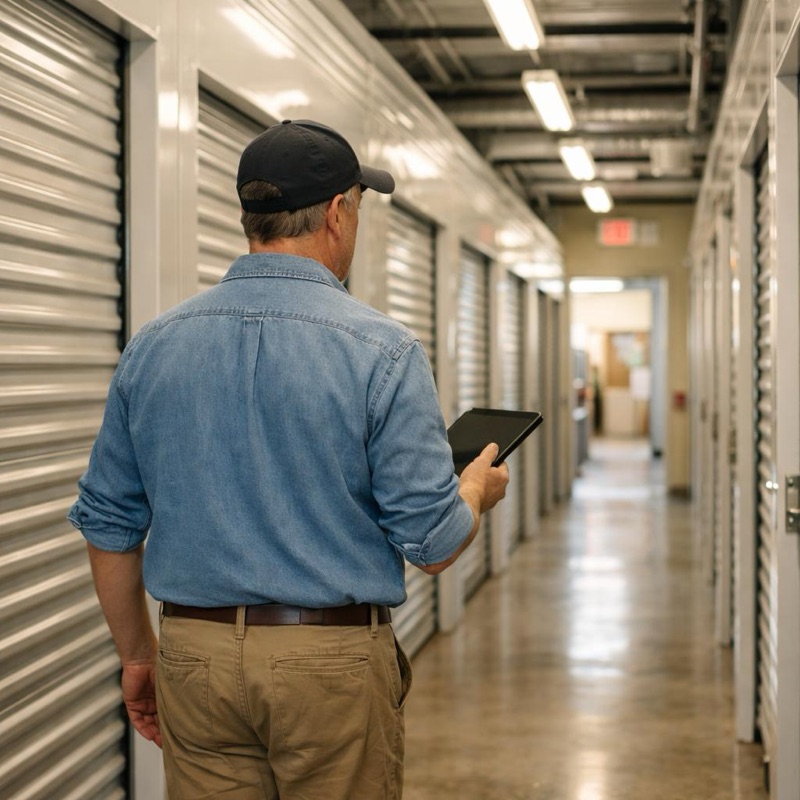
The short answer: storage businesses sold on the open market run from about $500,000 for smaller operations without real estate to $2.5M and up where property comes with the deal, with a median sale price of $990,000 at a median 3.36× owner earnings (sold-transaction data, 2021–2025). The defining trait: the real estate usually comes with the purchase, which lifts the price, anchors the value, and changes the loan you use.
Why buyers pay up for storage
Storage owns two traits buyers price in. Sticky, low-touch income: tenants rarely move out over a price increase that costs less than a weekend of hauling, and a facility runs with a fraction of the labor of almost any business at the same revenue. A real-asset floor: when the land and buildings convey, part of what you buy is property with value independent of the operation, which is why storage multiples sit above the general small-business norm. The trade-off is that "passive" varies more than the marketing suggests: some facilities run remote-managed, others need daily hands on rentals, collections, and gates, so what the current owner actually does each week is a diligence question, not an assumption.
What storage facilities sell for
| Measure | Typical figure | Notes |
|---|---|---|
| Median sale price | $990,000 | Asking median $1,085,000; sales close at ~92% of ask |
| Typical range | ~$500K to $2.5M+ | Lower without real estate; higher with property or specialization |
| Earnings multiple | 3.36× median (2.61–4.24×) | Bottom to top quartile of sold deals |
| Median owner earnings | $332,776 | On median revenue of $1,653,526 |
| Median days on market | 144 | Storage sells slower than most Main Street listings |
Two forces set where a specific facility lands in that range. The rent roll: occupancy, collected rates versus street rates, and tenant longevity are the income engine, and buyers pay for verified collections, not for a rate card. And the property: condition, expansion room, and local supply, because a new build nearby resets the rate environment. Larger institutional facilities are priced on income and cap rates like commercial real estate; Main Street facilities trade on the earnings multiples above. Cross-check any candidate against the multiples table and our valuation guide.
The diligence that makes or breaks a storage deal
Storage diligence is rent-roll forensics. Pull the management software reports and reconcile them against bank deposits and tax returns, the same financial-first discipline as any acquisition. Then go unit by unit:
| What to verify | The question it answers | Where it shows up |
|---|---|---|
| Occupancy and collected rates | Is the stated income real, at real rates? | Management software vs deposits |
| Tenant longevity and delinquency | How sticky is the income; how much is in arrears? | Rent roll history, lien-sale log |
| Property condition and expansion room | What capital does year one actually need? | Site inspection, permits |
| Local supply pipeline | Is a competitor building nearby? | County permit filings |
| Owner's real workload | Is this the passive asset it claims to be? | Ask what the owner does weekly |
The number that catches inflated storage deals
Collected revenue per occupied unit versus the street rate card. A facility quoting $120 units while actually collecting $85 after move-in specials is telling you its real market position, and its real income.
Licensing: low barrier, zoning is the gate
No professional license stands between you and storage ownership, which keeps the buyer pool broad. The regulatory questions are property questions: zoning compliance, any conditional-use permits, and the state's lien-sale rules that govern how delinquent units are auctioned. Your attorney handles these in the normal closing flow, per what an M&A attorney does.
How a typical storage deal is financed
Because the purchase is real-estate-heavy, storage routes through the SBA 504 program, built for property-backed deals, as often as the standard 7(a); the comparison is in SBA 504 vs 7(a). Illustrative 7(a) structure at the median sale price:
| Source | Amount | % of price |
|---|---|---|
| SBA 7(a) loan | $900,000 | 90% |
| Equity injection (total) | $100,000 | 10% |
| of which: standby seller note can cover | up to $50,000 | up to 5% |
| of which: your cash portion | as low as ~$50,000 | ~5% |
Either program, the lender's test is the same: the facility's cash flow must cover the debt with margin. Model it in the DSCR calculator, and the full stack logic lives in the acquisition financing guide.
Check a facility's debt coverage
Where to find self-storage facilities for sale
| Channel | What you find there | How to work it |
|---|---|---|
| Marketplaces | Smaller single-site facilities | Alerts on; start with the marketplace comparison |
| CRE brokers & storage specialists | Larger facilities, priced with the property | Brief them on your buy-box |
| Direct outreach | Long-hold individual owners; quiet sales are common | The off-market playbook |
Storage takes patience on the buy side too: at a median 144 days on market, good facilities move slower than most listings, which favors buyers with a defined buy-box and a standing sourcing pipeline.
Evaluating a storage facility?
The free training covers how members evaluate income, property, and financing on real-estate-heavy deals.
Every claim checkable: member closings, self-reported and published unedited.
Frequently asked questions
Sold-transaction data puts the median at $990,000, in a typical range from about $500,000 for smaller operations without real estate to $2.5M and up where property comes with the deal. The median earnings multiple is 3.36 times owner earnings, with sold deals spanning roughly 2.6 to 4.2 times.
Smaller single-site facilities list on the general business marketplaces; larger ones trade through commercial real estate brokers and storage specialists. Direct outreach works well too, because many facilities are held by long-term individual owners and sell quietly.
Yes. Because the purchase is real-estate-heavy, storage deals often use the SBA 504 program, built for property-backed purchases, instead of or alongside the 7(a). On a 7(a) structure the equity injection is 10%, about $100,000 at the median price, and up to half can be a standby seller note.
It varies more than the marketing suggests. Some facilities run remote-managed, others need daily attention for rentals, collections, and maintenance. Confirm what the current owner actually does each week before assuming the income is passive.
The rent roll first: occupancy, collected rates versus street rates, tenant longevity, and delinquency. Then reconcile software reports against bank deposits and tax returns, inspect the property for deferred capital needs, and check county permits for competing builds nearby.
Sources
Sale prices, multiples, revenue and days-on-market: BizBuySell Storage & Warehouse Valuation Benchmarks, businesses reported sold 2021–2025. SBA structure mechanics: our equity injection guide.