
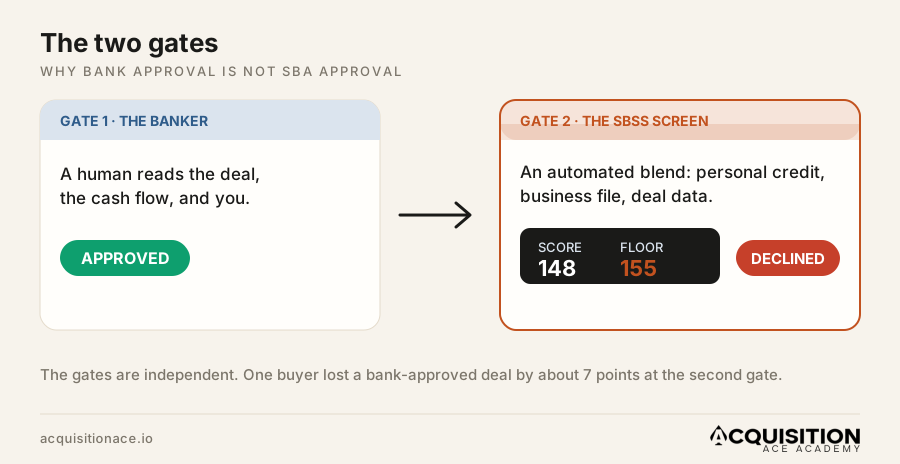
The SBSS, FICO's Small Business Scoring Service, is a blended score from 0 to 300 that combines your personal credit, the business's credit file, and the deal's financials. Many SBA 7(a) lenders use it as a pre-screen, commonly looking for roughly 155 to 165 or above, with each lender setting its own floor. And yes: a loan a banker has verbally approved can still fail the screen. One buyer described missing the cutoff by about 7 points after bank approval, because the banker's judgment and the automated screen are two separate gates. What feeds the score, where the floors sit, and the levers that move it are below.
Update, SOP 50 10 8.1 (effective October 1, 2026): the SBA is sunsetting the SBSS screen for 7(a) small loans, and streamlined small-loan processing is no longer available for changes of ownership at all. Every acquisition now runs full standard 7(a) underwriting: a credit memorandum, an independent valuation, and a historical cash-flow test at a 1.25× DSCR floor. The score below still describes how lenders screened files through September 2026, and many desks still run it internally; ask each lender how they screen now. Details on the SOP 50 10 8 and 8.1 page.
What goes into the score
SBSS is not a second name for your FICO. It blends three layers, and for a first-time buyer purchasing through a new entity, the weighting leans heavily on the first:
| Input | What it covers | Why it matters for a buyer |
|---|---|---|
| Personal credit of the owners | FICO data for every 20%+ owner who signs the personal guarantee | The heaviest input for a first-time buyer; a weak co-owner drags the blend |
| Business credit file | Trade lines, payment history, and public records of the entity | A brand-new buying entity has a thin file by definition; some lenders re-weight toward personal data in that case |
| Application and financial data | The deal's own numbers: cash flow, structure, industry | The same buyer scores differently on different deals |
The blend is why two buyers with identical FICO scores can land on opposite sides of a lender's floor, and why you cannot fix an SBSS problem by staring at your personal report alone. You also cannot pull your own SBSS: it is sold to lenders, not consumers. The practical move is to ask each lender early whether they pre-screen on SBSS and what floor they use, so the invisible gate is on the table before diligence money is spent.
Where the floors sit
| Band | Score | What it means in practice |
|---|---|---|
| Common lender comfort zone | 165+ | Clears most desks' internal floors with margin |
| The common pre-screen bar | ~155–165 | Where many 7(a) lenders set the gate; passing is deal-by-deal |
| Below the bar | <155 | Routinely screened out even when the banker likes the deal |
Floors are lender policy, not a single SBA-published number, and they change over time, which is exactly why the same file can die at one desk and close at another. Our credit score requirements guide covers how the SBSS sits alongside the ~680 personal FICO guideline most lenders underwrite to.
How it kills approved deals
The failure pattern shows up in buyer forums in almost identical words. One buyer put it plainly:
Approved for a loan by the bank, but denied by the SBA... came short of the FICO small business scoring score by about 7 points. (a buyer, r/smallbusiness)
The sequence: the underwriter likes the deal, terms are discussed, the file moves to the screening step, and the SBSS lands a few points under the floor. The banker approved; the screen declined; nothing about the business changed. If this happens to you, treat it as a decline with specific fixes, not a verdict on the deal.
The levers that move it
| Lever | Why it works | Speed |
|---|---|---|
| Cut personal card utilization | Utilization is a heavyweight FICO input, and FICO feeds the blend | One to two statement cycles |
| Resolve disputes and collections | Public negatives hit both the personal and business layers | Weeks to months |
| No new credit during the search | Inquiries and new lines depress the score exactly when it is read | Immediate |
| Add a stronger co-borrower | The blend averages every guarantor; a strong partner lifts the floor math | Deal-structure decision |
| Change lenders | Floors differ by desk; the score that fails one screen passes another | Days, run them in parallel |
Buyer's move
In the first lender conversation, ask three questions in one breath: do you pre-screen on SBSS, what floor do you use, and when in your process does the screen run. A lender who answers crisply has told you they run a real process; one who dodges has told you where your deal will die.
Frequently asked questions
The FICO Small Business Scoring Service: a blended 0-to-300 score combining personal credit of the guarantors, the business credit file, and the deal's financial data. Many 7(a) lenders pre-screen applications on it, with a common bar around 155 to 165 and each lender setting its own floor.
Yes. The banker's approval and the automated screen are separate gates, and buyers report losing bank-approved deals by a handful of SBSS points. The fixes: a different lender with a different floor, a stronger co-borrower in the blend, or one to two cycles of credit repair before reapplying.
No, it is sold to lenders, not consumers. Manage the inputs instead: personal utilization and disputes, no new credit during the search, and the business credit file. Ask every lender early whether they screen on SBSS and at what floor.
There is no single SBA-published minimum; many lenders look for roughly 155 to 165 or above on the 0-to-300 scale, and floors vary by desk and over time. Because floors differ, a near-miss at one lender is an argument for the next lender, not for abandoning the deal.
Sources
- SBSS composition and thresholds, FICO Small Business Scoring Service lender documentation; typical floors per lender guidance incl. Live Oak Bank, Windsor Advantage, NAGGL (2025 to 2026), consistent with our credit score requirements page.
- Bank-approved-then-screen-declined pattern: buyer reports in r/smallbusiness (2024 to 2026 threads).
- Equity injection and underwriting framework, SBA 7(a) program; SOP 50 10 8.1 (effective October 1, 2026). See our SOP 50 10 8 changes guide.