
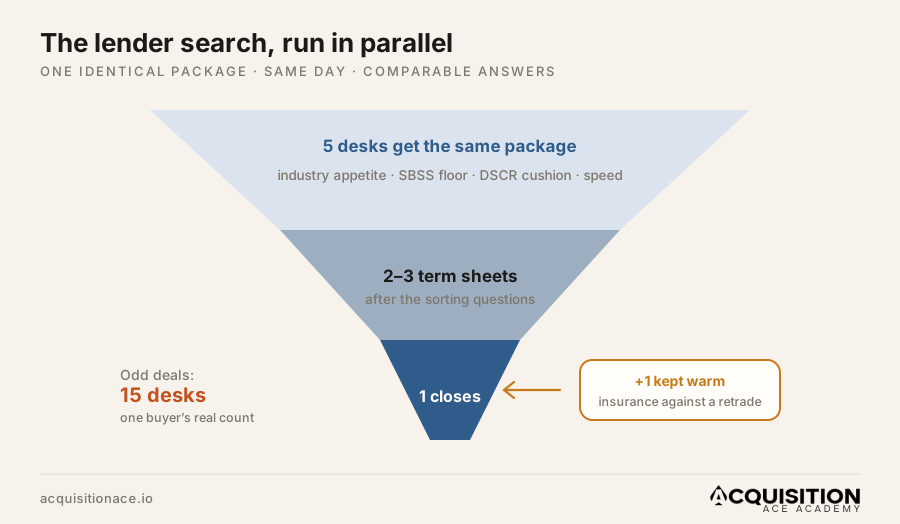
Three to five lenders, in parallel, for a normal acquisition. SBA lenders are not interchangeable: each layers its own credit box over SBA rules, its own industry appetite, its own SBSS floor, and its own speed, so the same deal gets different answers from different desks. Buyers of unusual deals report going much further, one described talking to fifteen lenders before finding the fit, and that is persistence, not failure: the fourteen noes cost emails, not money. The efficiency trick is one loan package sent to every desk the same day, so five conversations cost barely more than one. The sorting questions and the week-by-week process are below.
Why the same deal gets different answers
Every lender runs its own credit policy on top of SBA rules, and the differences are large enough to decide your deal:
| Dimension | The range you will meet | Why it decides deals |
|---|---|---|
| Industry appetite | One desk funds restaurants, the next refuses them | A decline can be category policy, not your file |
| SBSS floor | Floors commonly differed across the ~155–165 band; being sunset under SOP 50 10 8.1, ask how each desk screens now | The score that fails one screen passes another |
| DSCR cushion | 1.15× at one desk, 1.25×+ demanded at another | Thin-cash-flow deals live or die here |
| Collateral policy | From flexible to lien-everything | Decides what personal assets get pledged |
| Process and speed | In-house teams vs routed through service providers | 45 days at one desk can be 120 at another |
Shopping lenders is not disloyalty; it is how the market is supposed to work, and the most active acquisition lenders expect it. One buyer's version of the lesson - and under SOP 50 10 8.1 (effective October 1, 2026) every acquisition runs full standard underwriting at a 1.25× historical DSCR, so the differences between desks show up earlier and matter more:
I probably talked to at least 15 different lenders before I found one who fit my vision and preferred deal structure. (a buyer, r/smallbusiness)
The sorting questions, and the answers that disqualify
| Ask | Keep them if | Drop them if |
|---|---|---|
| Have you funded this industry in the last year? | Yes, with examples | "We look at everything" |
| Do you pre-screen on SBSS, and at what floor? | A number, stated plainly | Vagueness about their own process |
| Is your letter credit-approved or a proposal? | They explain the difference unprompted | They blur the two |
| Typical days from package to close? | A range with a recent example | "Depends" with no number |
| Who makes the final decision? | Named committee and cadence | Your contact pretends it is them |
The parallel process, week by week
- Week 1: one package to every desk. Your financials, the business's three years of returns plus interims, the deal structure, one PDF or data room. Identical for all, same day, so answers are comparable.
- Week 2: sort on the questions above. Expect five conversations to become two or three term sheets; wrong answers disqualify fast, which is the point.
- Weeks 3 to closing: two warm to the end. The runner-up is your insurance against a late retrade. Tell both they are in a process; neither will be surprised, and the honest ones respect it.
- Odd deals: widen or delegate. Low collateral, thin-file borrower, franchise resales, partial buyouts, or an industry most banks avoid all shrink the pool, and the honest number becomes "as many as it takes." For those, a packager who already knows which desks say yes can replace ten cold conversations; the trade-offs are in brokers vs going direct.
Buyer's move
Build the package before the first call, not after. A buyer who sends a complete, identical file to five desks on Monday gets comparable term sheets by the next week; a buyer who trickles documents gets five different half-conversations and no leverage. The package is the strategy.
Frequently asked questions
Talk to three to five in parallel with one identical loan package sent the same day. Expect that to narrow to two or three term sheets, then keep a runner-up warm through closing as protection against late term changes. Unusual deals can honestly take ten or more conversations to place.
Early conversations and pre-qualification generally run on the package you provide; hard pulls come at formal application. Ask each lender when they pull credit, and cluster any formal applications tightly so scoring models read them as one search.
Each lender layers its own credit box over SBA rules: industry appetite, SBSS floors, DSCR cushions, collateral policy, and committee taste all differ. A decline at one desk says little about the next, which is the entire argument for running desks in parallel.
For a straightforward Main Street deal, direct conversations with three to five active acquisition lenders work well. For odd deals, a packager who already knows which desks fund your situation can replace ten cold conversations; weigh the fee against that saved month.
Sources
- Lender-shopping behavior and the fifteen-lender account: r/smallbusiness buyer threads (2021 to 2026).
- Desk-level differences in floors, cushions, and speed: lender guidance incl. Live Oak Bank, Windsor Advantage, NAGGL (2025 to 2026); see our most active SBA acquisition lenders.
- Equity injection and underwriting framework, SBA 7(a) program; SOP 50 10 8.1 (effective October 1, 2026). See our SOP 50 10 8 changes guide.