
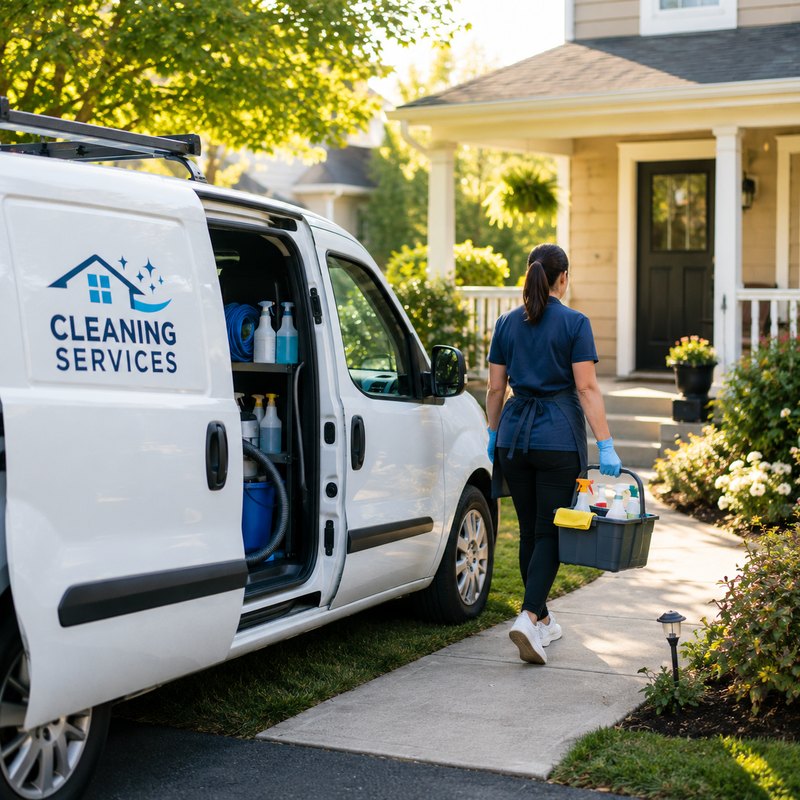
The short answer: Buy a cleaning company on its recurring commercial contracts, not on one-off residential jobs. Expect ~2.3× SDE (about 0.7×, 0.8× revenue), ~10% down with an SBA 7(a) loan, and heavy diligence on contract assignability, customer concentration, and worker classification (W-2 vs 1099). No specialized license is usually required, but bonding and insurance are.
Know which cleaning business you're buying
"Cleaning" spans very different economics. The financeable, resilient version is commercial janitorial, recurring monthly contracts with offices, medical buildings, schools, and industrial sites. Residential maid services and one-off jobs are more transactional and churn faster. Specialty niches, post-construction, medical/biohazard, floor care, command higher rates but need extra certification. Underwrite the contract base, not the brand.
A janitorial company is a book of contracts wearing a uniform. Buy the contracts.
Licensing, bonding & insurance
Unlike a trade, commercial cleaning usually needs no specialized occupational license to operate. What it does need, and what clients demand, is:
- General business license in the operating jurisdiction.
- General liability insurance, required by nearly every commercial client and often written into contracts.
- Workers' compensation, mandatory in most states once you have employees, and a real cost in a labor-heavy business.
- Janitorial / surety bond, a "cleaning bond" that protects clients against theft or damage; frequently a condition of winning contracts.
- Specialty certifications, mold remediation, biohazard, or healthcare cleaning if the book includes them.
Confirm insurance transfers cleanly
Many commercial contracts name the client as an additional insured and require specific coverage limits. Verify you can replicate the seller's coverage before close, or a contract can lapse on day one.
What cleaning businesses cost
| Metric | Range | Anchor |
|---|---|---|
| SDE multiple | 2.0×, 3.5× | ~2.30× |
| Revenue multiple | 0.62×, 0.78× | ~0.78× |
| Net profit margin (small firms) | 10%, 24% | ~18.8% |
| SBA down payment | 10% | 10% |
BizBuySell's benchmark shows the janitorial earnings multiple climbed from 2.0× (2021) to 2.3× (2025) and the revenue multiple from 0.62× to 0.78×, while margins thinned under competitive bidding, pushing median SDE up only 17% against 25% revenue growth. Translation: revenue is easier to grow than margin here. See live comps on the cleaning multiples page and price a target with the valuation calculator.
Value a cleaning company fast
Enter revenue, SDE, and a multiple, get a defensible range.
Diligence: contracts and labor
Two files make or break a janitorial deal, the contract book and the payroll.
- Contract assignability & term. Read every anchor contract. Are they assignable on a change of ownership, or do they require client consent? What's the term and cancellation notice (many are 30-day)? Month-to-month revenue prices lower than multi-year agreements.
- Customer concentration. If one or two accounts are a large share of revenue, a single loss reshapes the deal, structure for it.
- Worker classification. The big landmine. Cleaners misclassified as 1099 contractors when they function as employees create back-tax, workers'-comp, and penalty exposure. Verify W-2 status or price the correction in.
- Wage and turnover reality. Confirm real loaded labor cost, overtime, and turnover, thin margins live or die on labor.
1099 misclassification is a deal-killer
If the seller runs a "1099 crew," you may inherit reclassification liability. Get a legal read and adjust price, or require the seller to convert and indemnify before close.
Deal structure & financing
Because value is contracts and goodwill, structure to protect retention: a seller note, a short transition so the seller re-introduces key accounts, and sometimes a holdback tied to contracts retained through 90 to 180 days. On financing, cleaning companies are solid SBA 7(a) candidates, plan for ~10% down, a 1.15×, 1.25× DSCR, and a seller note in the stack. Model it in the valuation calculator.
Go deeper on the numbers
See how much cleaning business owners make and what it costs to buy one, with worked math.
Frequently asked questions
Usually no specialized occupational license, just a general business license, general liability insurance, workers' comp, and often a janitorial/surety bond that clients require. Specialty work like mold or biohazard cleanup needs separate certifications.
Roughly 2.3× SDE or about 0.7×, 0.8× revenue. BizBuySell shows the earnings multiple rose from 2.0× (2021) to 2.3× (2025) and revenue from 0.62× to 0.78×.
Customer concentration and labor. Confirm anchor contracts are assignable, that key workers stay, and that cleaners are properly classified as W-2 rather than misclassified 1099, which can create back-tax liability.
Yes, recurring contracts and low asset intensity make them solid SBA 7(a) candidates. Expect ~10% down, a 1.15×, 1.25× DSCR, and often a seller note. Lenders focus on retention and assignable agreements.
Sources
- Cleaning & janitorial multiples and benchmarks, BizBuySell Valuation Benchmarks (2025).
- Net profit margins, CleanerHQ margin data (2026).
- Bonding, insurance & worker classification, state business-licensing guidance and IRS/DOL worker-classification rules.