The short answer: Construction businesses price off the transaction averages: 2.56× SDE general (408 reported deals), 2.98× heavy construction, about 0.60× revenue. That puts a $1M-revenue contractor near $600,000, a $3M contractor near $1.8M, and an $8M bonded operation near $4.8M. With an SBA 7(a) loan the 10% injection on total project cost is about $100K on a $1M company, half coverable by a standby seller note, so your cash can start near ~$50,000 plus reserves.
What construction businesses actually cost
Price scales with revenue, backlog quality, and whether the bonding survives the sale:
| Contractor | Revenue | Implied SDE | Typical price |
|---|---|---|---|
| Owner-led crew work | $1M | ~$180K | ~$600,000 |
| Estimator on staff | $3M | ~$450K | ~$1.8M |
| Bonded commercial work | $8M | ~$1M | ~$4.8M |
The number that moves these figures is not revenue, it is the backlog: signed contracts with verified margin remaining price above the averages, while billings running ahead of costs price below them, and the WIP schedule is where the difference shows.
How the price is set: the multiple
Three sourced methods across the same datasets:
| Method | Implied price | Reading |
|---|---|---|
| 2.56× SDE, general average | ~$640,000 | Across 408 reported transactions |
| 2.98× SDE, heavy construction | ~$745,000 | 65 reported transactions; equipment and contract durability |
| 0.60× revenue on $3M | ~$1.8M | The revenue yardstick for a staffed contractor |
Appraiser ranges run 2.16–2.85× for the $1–5M cohort, bracketing the transaction averages. See the sourced figures on the construction business multiples data page and the mechanics in valuation.
Price the backlog, not the trucks. A signed contract with margin left is the only revenue you are actually buying.
The down payment and the full capital stack
Under SBA 7(a) rules (SOP 50 10 8.1, effective October 1, 2026, which kept the injection rules unchanged), a change of ownership needs a minimum 10% equity injection, calculated on the total project cost, the price plus financed fees, not on the loan amount. Up to half of it can be a seller note on full standby, and the injection cannot come from borrowed funds. The worked stack on a $1,000,000 construction business:
| Source / use | Amount | % of price |
|---|---|---|
| SBA 7(a) bank loan | $900,000 | 90% |
| Your cash injection | $50,000 | 5% |
| Seller note (full standby) | $50,000 | 5% |
| Purchase price | $1,000,000 | 100% |
| + Est. closing costs & fees (financed) | ~$35,000 | |
| + Working-capital reserve | $50K–$80K |
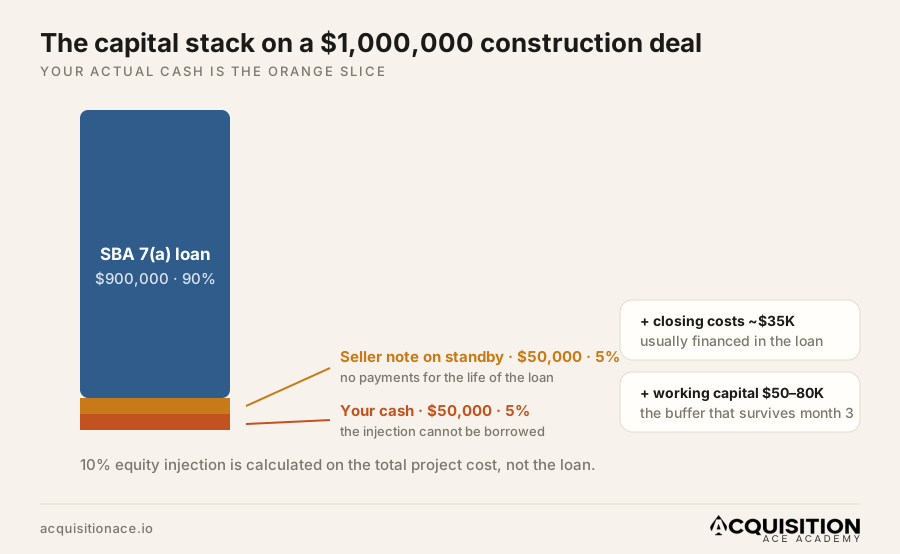
The honest cash to close is the ~$50,000 injection plus a working-capital reserve sized to the job cycle, because construction pays in draws and retainage, not on delivery. The injection runs on total project cost and cannot be borrowed. The deal-specific checks, license transfer and the surety relationship, decide whether the company can keep bidding the day after closing.
Does the deal cash-flow?
At ~$250K SDE and roughly $152K of annual debt service on a $935K financed total, coverage sits near 1.65×, acceptable if the backlog margin is real, which is exactly what the job-by-job WIP review establishes. Check any structure against a DSCR of ~1.15× to 1.25× before you sign anything.
Costs buyers forget
- Bonding and license transfer, the surety relationship and state board rules; without them the company cannot bid.
- Retainage and the draw cycle, cash arrives months behind work; size the buffer to the job cycle.
- SBA guarantee & packaging fees, a percentage of the guaranteed amount, usually financed.
- Legal & closing, purchase agreement, contract and warranty assignments.
- Estimator and PM retention, who wins and runs the next job; non-solicits and stay terms in writing.
- Warranty exposure on finished work, claim history and terms; finished jobs can come back.
Model your construction business deal end to end
Price, down payment, loan payment, and take-home in one place.
Frequently asked questions
Roughly $600,000 for a $1M-revenue contractor, $1.8M at $3M, and $4.8M at $8M, derived from the sourced 0.60× revenue average, with general construction averaging 2.56× SDE across 408 reported transactions and heavy construction 2.98×.
An SBA 7(a) purchase needs a 10% equity injection on the total project cost, about $100,000 on a $1M company. Up to half can be a standby seller note, so your own cash can start near $50,000 plus closing costs and a draw-cycle reserve.
The WIP schedule tied job by job to contracts, billings, and costs; executed backlog with margin remaining; license and bonding transfer; and who estimates and runs jobs after the seller leaves. Those four checks decide whether the stated earnings are real.
On the total project cost, not the loan amount, and it cannot come from borrowed funds. A seller note on full standby can cover up to half of the required injection.
Sources
- Transaction averages, Sundance Financial, SDE Multiples by Industry (2026), averages across 9,500+ small-business transactions reported in 2025.
- Appraiser ranges, Peak Business Valuation ($1–5M cohort).
- Multiples, Acquisition Ace construction multiples.
- Financing structure & equity injection, SBA 7(a) program; SOP 50 10 8. See our SBA loan guide.