The short answer: Electrical businesses price off the transaction averages: 2.94× SDE across 57 reported deals, about 0.59× revenue, with appraiser ranges at 2.22–2.89×. That puts an $800K-revenue shop near $470,000, a $1.5M shop near $885,000, and a $3M commercial operation near $1.8M. With an SBA 7(a) loan the 10% injection on total project cost is about $60K on a $600K shop, half coverable by a standby seller note, so your cash can start near ~$30,000 plus reserves.
What electrical businesses actually cost
Price scales with revenue and the share of it that recurs without bidding:
| Shop | Revenue | Implied SDE | Typical price |
|---|---|---|---|
| Owner on the tools plus a crew | $800K | ~$140K | ~$470,000 |
| Service trucks and a dispatcher | $1.5M | ~$250K | ~$885,000 |
| Commercial contracts | $3M | ~$450K | ~$1.8M |
The quiet variable in every electrical price is the license bench: a shop whose only qualifying license holder is the seller has a licensing problem attached to its price, and the transition plan becomes the deal.
How the price is set: the multiple
The sourced figures on a $200K-SDE shop:
| Method | Implied price | Reading |
|---|---|---|
| 2.22× SDE, appraiser low | ~$444,000 | Bid-only work, thin service base |
| 2.94× SDE, transaction average | ~$590,000 | What sold shops actually averaged |
| 0.59× revenue on $1.5M | ~$885,000 | The revenue yardstick for a staffed shop |
The transaction average sits at the top of the appraiser range because sold shops skew service-heavy and properly staffed. See the sourced figures on the electrical business multiples data page and the mechanics in valuation.
The trucks roll on the license. Secure the bench before you price the book.
The down payment and the full capital stack
Under SBA 7(a) rules (SOP 50 10 8.1, effective October 1, 2026, which kept the injection rules unchanged), a change of ownership needs a minimum 10% equity injection, calculated on the total project cost, the price plus financed fees, not on the loan amount. Up to half of it can be a seller note on full standby, and the injection cannot come from borrowed funds. The worked stack on a $600,000 electrical business:
| Source / use | Amount | % of price |
|---|---|---|
| SBA 7(a) bank loan | $540,000 | 90% |
| Your cash injection | $30,000 | 5% |
| Seller note (full standby) | $30,000 | 5% |
| Purchase price | $600,000 | 100% |
| + Est. closing costs & fees (financed) | ~$25,000 | |
| + Working-capital reserve | $30K–$50K |
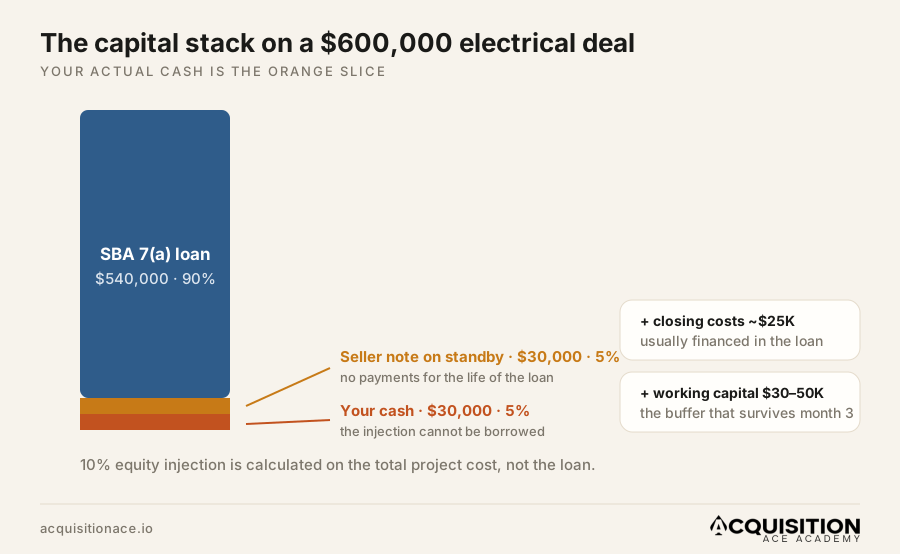
The honest cash to close is the ~$30,000 injection plus reserves. The injection runs on total project cost and cannot be borrowed. The deal-specific item is the qualifier: who holds the license the company operates under after closing, settled in writing before the price conversation finishes.
Does the deal cash-flow?
At ~$200K SDE and roughly $93K of annual debt service on a $575K financed total, coverage sits near 2.1×, comfortable, provided the service book and the license bench survive the transition. Check any structure against a DSCR of ~1.15× to 1.25× before you sign anything.
Costs buyers forget
- License and qualifier continuity, who qualifies the company after closing; state board rules differ.
- SBA guarantee & packaging fees, a percentage of the guaranteed amount, usually financed.
- Legal & closing, purchase agreement, permit and warranty assignments.
- Open permits and inspections, unfinished obligations convey with the company.
- Callback and warranty history, finished work that comes back erodes year-one margin.
- Working capital, commercial accounts pay on terms; the buffer carries payroll meanwhile.
Model your electrical business deal end to end
Price, down payment, loan payment, and take-home in one place.
Frequently asked questions
Roughly $470,000 for an $800K-revenue shop, $885,000 at $1.5M, and $1.8M at $3M, derived from the sourced 0.59× revenue average, with sold shops averaging 2.94× SDE across 57 reported transactions.
An SBA 7(a) purchase needs a 10% equity injection on the total project cost, about $60,000 on a $600,000 shop. Up to half can be a standby seller note, so your own cash can start near $30,000 plus closing costs and reserves.
You need the company to be qualified by a license holder, which does not have to be you: a tenured licensed electrician on staff, or the seller through a transition period, can qualify the company. Settle who it is in writing before closing.
On the total project cost, not the loan amount, and it cannot come from borrowed funds. A seller note on full standby can cover up to half of the required injection.
Sources
- Transaction averages, Sundance Financial, SDE Multiples by Industry (2026), averages across 9,500+ small-business transactions reported in 2025.
- Appraiser ranges, Peak Business Valuation ($1–5M cohort).
- Multiples, Acquisition Ace electrical multiples.
- Financing structure & equity injection, SBA 7(a) program; SOP 50 10 8. See our SBA loan guide.