
Why the license bench is the hidden multiple
An electrical shop operates under a qualifying license, and in many shops that license is the seller. A company whose only qualifier walks out at closing has a licensing problem before it has a business plan, which is why buyers price the bench: licensed electricians with tenure who can qualify the company and keep crews working. The revenue side sorts the same way every trade does: service and maintenance agreements recur and price high; a book of one-off builder jobs rebuys its revenue every quarter.
What buyers check first
- Service vs project split. Revenue by job type across 24 months; how much recurs without bidding?
- The license bench. Who besides the seller can qualify the company, and will they stay?
- Customer concentration. One builder or property manager carrying the book is the usual flag.
- Open permits and callbacks. Unfinished obligations and warranty history convey with the company.
The trucks roll on the license. Price the bench before the book.
Electrification is the growth story buyers pay for
EV charging, panel upgrades, and generator work are moving residential and light-commercial demand toward electrical shops, and books with that work in the mix carry a growth argument the average does not price. SBA-financed asset purchases are standard at this size, with the injection on total project cost; the worked stack is on the cost page.
Buyer's move
Pull the roster of licensed electricians with hire dates before the LOI, and ask directly who qualifies the company the day after closing. If the answer is only the seller, the transition plan is the deal.
Where it sits in its aisle
| Vertical | SDE multiple | Reported deals |
|---|---|---|
| Building material & hardware | 3.40× | 29 |
| Concrete | 3.04× | 21 |
| Heavy construction | 2.98× | 65 |
| Electrical & mechanical | 2.94× | 57 |
| HVAC | 2.80× | 123 |
| Plumbing | 2.62× | 61 |
| Other construction (general) | 2.56× | 408 |
Deal size and the multiple
One honest limitation of transaction averages: the dataset reports multiples, not deal sizes, and reported Main Street transactions skew toward smaller companies, so the averages above describe the heart of that market. Size changes the auction. At $500K+ of SDE the buyer pool shifts from individual owner-operators to searchers, funds, and family offices competing for the same listing, and electrical contractors at that size routinely price above the table. Read the average as the floor of the conversation on a larger deal, not the ceiling, and compare businesses to others of their own size before comparing across industries.
Reading an electrical listing against the average
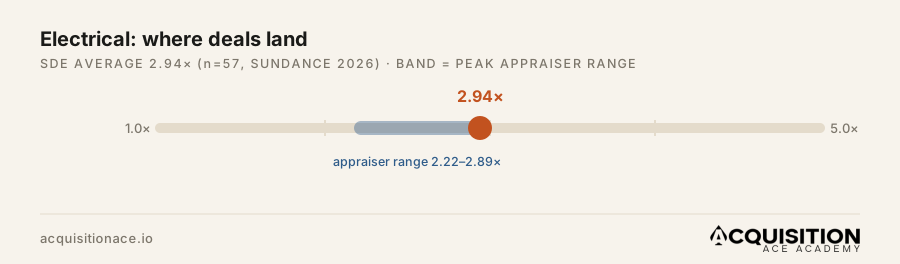
Electrical sits near the top of the trades (2.94× across 57 deals, above HVAC and plumbing) and above the Peak appraiser range, which tells you transactions have been pricing ahead of appraisals: exactly the setup for an appraisal-gap retrade if you pay the listing number without verifying. The checks: the license bench, who qualifies the company besides the seller, settled in writing before closing; service-contract share, recurring maintenance revenue versus one-time project work; and the appraisal question, priced in from the first offer. Worked financing on the cost-to-buy page.
Sources
- Sundance Financial, SDE Multiples by Industry (2026), averages across 9,500+ small-business transactions reported in 2025.
- Peak Business Valuation, electrical contracting ranges ($1–5M cohort).
Electrical valuation multiples, FAQ
An average of 2.94× SDE across 57 reported electrical and mechanical transactions, with appraiser ranges at 2.22–2.89× and about 0.59× revenue. Service mix and the license bench set the position.
Sold deals skew toward the service-heavy, well-staffed shops that actually transact, while the appraiser range describes the broader $1–5M cohort. A shop with recurring service revenue and a real license bench earns the transaction average.
About $885,000 at the 0.59× revenue average. The SDE method, the service share, and whether anyone besides the seller can qualify the company decide the real number.
Keep going
Compare every sector on the industry multiples hub, learn the buy playbook in our how to buy an electrical business guide, see the cash-to-close math on the cost to buy page, and price a deal with the valuation calculator.
Put a real number on a real deal
Drop in SDE and an asking price, our calculator returns a value range and a financing check in seconds.