
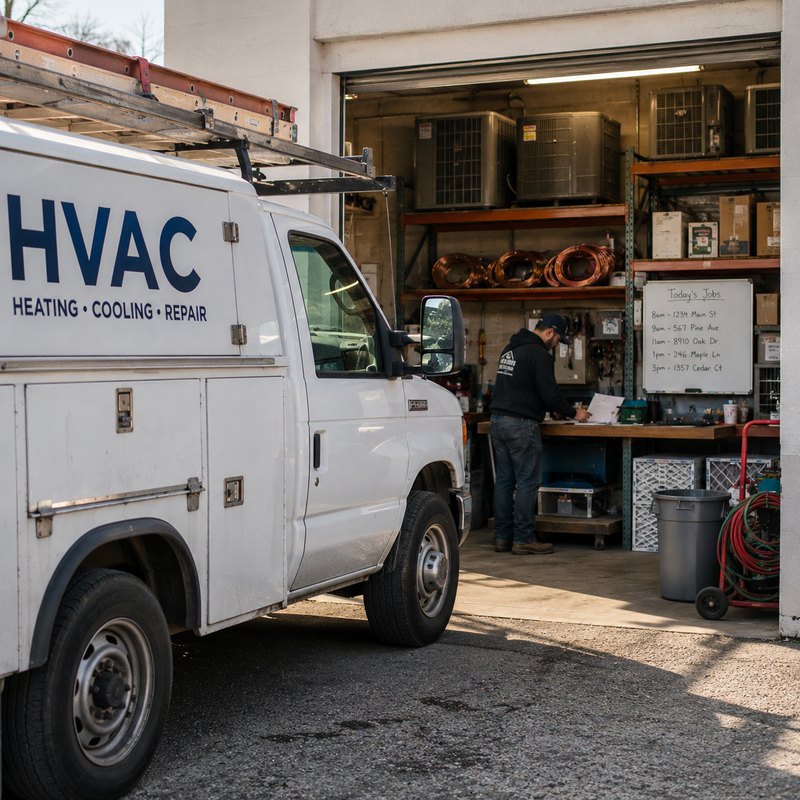
The short answer: The median HVAC business sells for about 2.80× SDE (roughly 1.7×, 3.7×), on median revenue near $1.1M and a median asking price around $648,500. Service- and maintenance-heavy shops trade at the top of the range; install-heavy shops at the bottom. You don't need to be a licensed tech to own one, but the company must run under a contractor license, usually tied to a qualifying individual, not the LLC. Most buyers finance with an SBA 7(a) loan at ~10% down. Run any target through the valuation calculator.
Why HVAC is a strong first acquisition
Air conditioning and heat are not optional. When a compressor dies in an Arizona August or a furnace quits in a Minnesota January, the homeowner pays that day, which is why HVAC revenue is durable through recessions and why the business throws off real cash. Two structural facts make it attractive to a buyer:
- Recurring service agreements. Residential maintenance plans run $150, $250 per year each, and agreement customers convert to replacement installs at 3 to 4× the rate of one-off customers. A book of transferable agreements is the single most valuable asset in the business. (FieldEdge; Lake Country Advisors)
- A structural labor moat. The BLS projects roughly 40,100 openings a year through 2034 and industry groups warn of up to 225,000 unfilled technician roles within five years. An existing, trained crew is nearly impossible to replicate from scratch, which is exactly why you buy instead of start. (BLS OOH; ServiceTitan)
You are not buying trucks and tools. You are buying a trained crew and a book of customers who call one number when it's 98 degrees.
What HVAC businesses sell for
The multiple rewards recurring revenue and punishes owner-dependence. Here is the 2026 landscape, from small owner-operator shops to platform-sized companies:
| Business size | Typical multiple | Basis | Notes |
|---|---|---|---|
| Small shop (1 to 3 trucks) | 2.75×, 3.25× | SDE | Median SDE multiple ~2.80×; range 1.7×, 3.7× |
| Revenue rule of thumb | 0.66× | Revenue | Median revenue multiple across sales |
| $1M, $5M EBITDA (residential) | 7.9×, 9.2× | EBITDA | Larger, service-heavy, systematized |
| PE platform valuation | 17×, 20× | EBITDA | What consolidators are valued at, the arbitrage |
See the live figure and full dataset on HVAC multiples. The gap between the ~2.8× a small shop trades for and the 17×, 20× a PE platform is valued at is the roll-up thesis, and it's an opportunity: a buyer who shifts an install-heavy shop toward service agreements expands both margin and exit multiple.
Half of listed HVAC businesses never sell
Roughly 52% of HVAC companies that go to market don't close, usually because the financials are messy or the business can't run without the owner. Clean books and a documented crew are what separate a sellable business from a listing. (First Page Sage)
Licensing: the trap that catches first-time buyers
There is no national HVAC license. Instead you have a patchwork: 36 states require a statewide HVAC contractor license, and the rest license at the city or county level. Two things every buyer must understand before writing an offer:
- The license is usually tied to a person, not the company. Most states license through a qualifying individual ("qualifier"). In an asset sale, the seller's license does not automatically travel to you. If you aren't licensed yourself, you must retain the seller's qualifier through a transition period, hire a licensed qualifier, or earn the license, plan for this in your deal structure and transition agreement.
- EPA Section 608 certification is federally required for anyone handling regulated refrigerant, and it stays with each technician, so it transfers with your crew, not with the sale. NATE certification is optional but signals quality and can protect manufacturer warranty standing.
- Bonding & insurance: states commonly require a surety bond (often around $15,000) plus general liability to hold or renew the license.
Confirm license transferability in writing before closing
Strict states (California and others with statewide boards) will not simply "transfer" a license with the business. Make license continuity, a retained qualifier or your own, a closing condition, not a post-close scramble. (Insureon; state contractor boards)
What to diligence in an HVAC deal
General financial diligence applies to every business. These are the items specific to HVAC that move price or blow up deals:
- Service-agreement quality & assignability. Count them, verify the annual value, and read the contracts, if agreements aren't in writing or don't survive a change of ownership, the recurring revenue does not transfer. A clean, assignable book can be worth 2 to 3× its annual recurring value on its own.
- Service vs. install revenue mix. A shop with 50%+ service/maintenance revenue earns a premium of one to two extra turns over an install-heavy shop. Install spikes revenue but adds volatility and slower collections.
- Technician staffing & retention. Who holds the licenses? What's the tenure and turnover? Is the owner the top salesperson? Owner-centrality is the #1 value killer.
- Fleet age & capex. Trucks are depreciating operating assets, not value. Underwrite replacement cost as a deduction.
- Customer & channel concentration. Heavy reliance on one builder or a few commercial accounts is risk. So is exposure to new-construction cycles versus steadier replacement demand.
- Warranty liabilities & seasonality of cash. Model the slow shoulder seasons, see below.
Want the full checklist and a real deal walk-through? See the HVAC acquisition case study and our guide to how to buy a business.
Seasonality and the "profitable but broke" trap
Roughly 60 to 70% of HVAC revenue clusters into summer cooling and winter heating, peaks in June, August and December, February, with slow spring and fall shoulder seasons. The danger for a new owner is the profitable-but-broke trap: peak-season volume masks the fact that payroll, fleet notes, insurance, and rent keep hitting through the slow quarters while install receivables lag. Model a working-capital line and stress-test the lowest quarter before you commit. (Steph's Books; Relay)
How a typical HVAC deal is structured
Most first-time buyers use an SBA 7(a) loan. On a $650,000 HVAC business:
| Source | Amount | % of price |
|---|---|---|
| SBA 7(a) bank loan | $585,000 | 90% |
| Your cash injection | $32,500 | 5% |
| Seller note (full standby) | $32,500 | 5% |
| Total | $650,000 | 100% |
Lenders will size the loan so cash flow covers debt at a DSCR of about 1.15×, 1.25×. See the full worked money math on what it costs to buy an HVAC business, and what you'll actually take home on how much HVAC owners make.
Price an HVAC deal in minutes
Drop in SDE and a multiple to get a defensible valuation range.
Where to find HVAC businesses for sale
Trades businesses still sell through relationships, so the broker channel punches above its weight here:
| Channel | What you find there | How to work it |
|---|---|---|
| Marketplaces | Steady HVAC inventory nationwide | Alerts to your buy-box; see the marketplace comparison |
| Local brokers | The best shops often sell through a broker the owner has known for years | Get on their lists early |
| Direct outreach | Retiring owner-operators who never list | The off-market playbook in your metro |
The first question on any listing: what share of revenue is service and maintenance agreements versus installs? That ratio explains most of the multiple, per the range above. The second: who holds the qualifying license, and do they stay? Then run it through the deal scorer.
Frequently asked questions
The median HVAC business sells for about 2.80× SDE, with most deals between roughly 1.7× and 3.7×. Service-heavy shops trade at the top; install-heavy shops lower. Larger companies over $1M EBITDA move to EBITDA multiples near 8×, 9×. See HVAC multiples.
Not personally, but the company must operate under a contractor license, which in most states is tied to a qualifying individual. If you aren't licensed, retain the seller's qualifier through a transition, hire one, or earn your own. EPA 608 certification stays with each technician.
With an SBA 7(a) loan you need about a 10% equity injection, roughly $65,000 on a $650,000 shop, and up to half can be a seller note on full standby, so your own cash could be nearer $32,500 plus closing costs and working capital. See cost to buy an HVAC business.
They buy small shops at 5×, 8× EBITDA and roll them into platforms valued at 17×, 20×. Recurring maintenance revenue, low capex, and non-discretionary demand make HVAC an ideal roll-up, Apex Service Partners alone closed dozens of add-ons in 2025.
The general marketplaces carry steady inventory, but many of the best shops sell through local brokers the owner has known for years, so briefing brokers on your buy-box matters more in the trades than in most industries. Direct outreach reaches retiring owner-operators who never list.
Sources
- SDE & revenue multiples, median price/revenue, BizBuySell HVAC valuation benchmarks (2021 to 2025), via ClearlyAcquired and MBO Ventures summaries.
- EBITDA multiples by size, First Page Sage HVAC EBITDA study (2025).
- Service-agreement economics, FieldEdge; Lake Country Advisors.
- Licensing & EPA 608, Insureon; state contractor boards.
- Labor shortage & technician wages, BLS Occupational Outlook Handbook; ServiceTitan.
- PE consolidation & platform multiples, Capstone Partners HVAC M&A update; PKF O'Connor Davies; Pipeline On.
- Seasonality & cash flow, Steph's Books; Relay.