
The short answer: Most landscaping deals settle between 2.0× and 4.0× SDE, with the typical sale near 2.56×, and median owner earnings in the industry surpassed $200,000 in 2025 as median sale prices jumped ~20%. Simple residential mow-and-blow routes trade at the low end; shops built on recurring commercial maintenance contracts trade at the top. There is no national license, but if the company sprays chemicals it needs a certified pesticide applicator, a credential tied to a person, not the LLC. Most buyers finance with an SBA 7(a) loan at ~10% down. Price any target in the valuation calculator.
Why landscaping is a strong first acquisition
Grass keeps growing. Commercial properties, HOAs, and municipalities are contractually and often legally required to keep their grounds maintained, which is why a maintenance-led landscaping book throws off predictable, repeat cash. Three structural facts make it attractive to a buyer:
- Recurring commercial maintenance contracts. Unlike one-off installs, commercial and HOA maintenance runs on annual or seasonal agreements that renew year after year. A book of transferable maintenance contracts is the single most valuable asset in the business, it is the difference between buying a route and buying a job. (BrightView; Green Industry Pros)
- A hugely fragmented market. The U.S. landscaping industry is worth well over $150 billion and is dominated by small local operators, even the largest player, BrightView, holds low-single-digit share. That fragmentation is exactly why acquisition (not startup) is the smart entry, and why private equity is rolling shops up. (BrightView investor filings; IBISWorld summaries)
- Low capital intensity, real add-on revenue. Beyond mowing, owners layer on higher-margin services, fertilization, irrigation, hardscape, and in northern markets snow removal that fills the winter cash gap. Design/build and hardscape work carries 25%, 40% margins versus 10%, 15% for routine maintenance. (Lawn & Landscape; sharpsheets)
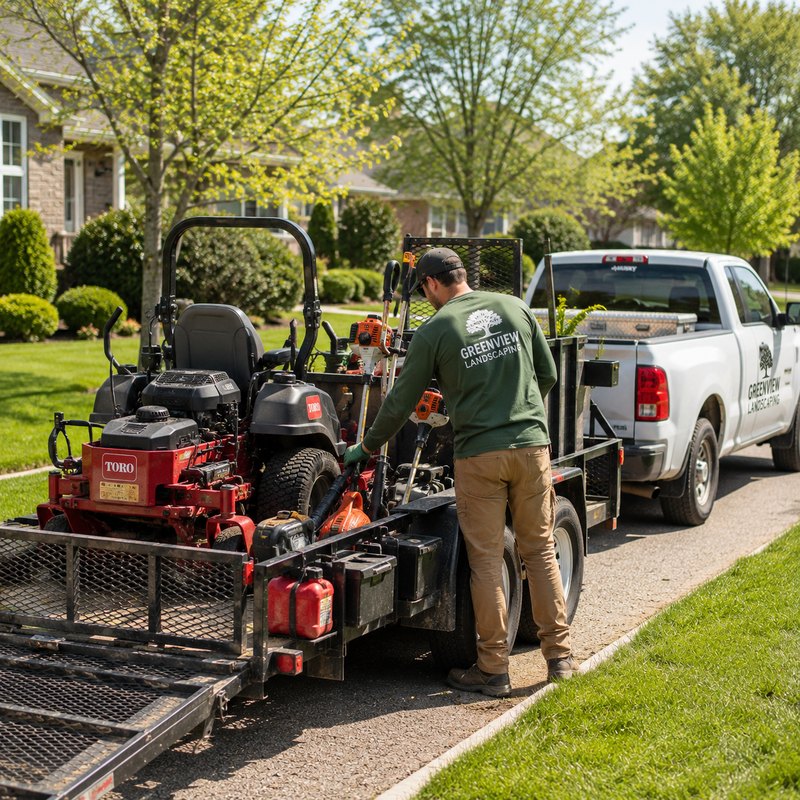
You are not buying mowers and trailers. You are buying a crew that shows up and a book of properties that renew every spring.
What landscaping businesses sell for
The multiple rewards recurring contract revenue and punishes owner-dependence and pure seasonality. Here is the 2026 landscape, from a residential mowing route to a platform-sized commercial company:
| Business type | Typical multiple | Basis | Notes |
|---|---|---|---|
| Residential mow-and-blow route | 2.0×, 2.5× | SDE | Owner-run, seasonal, low switching cost |
| Maintenance-led shop (typical deal) | 2.4×, 2.8× | SDE | Median SDE multiple ~2.56×; mixed residential/commercial |
| Commercial-contract heavy | 3.0×, 4.0× | SDE | Recurring agreements, crews & systems, lower churn |
| Design/build & hardscape | 2.0×, 3.0× | SDE | Higher margin but project-based & lumpier |
| Regional / PE platform | 7×+ | EBITDA | What consolidators pay & are valued at, the arbitrage |
See the live figure and full dataset on landscaping multiples. The gap between the ~2.56× a small maintenance shop trades for and the high-single-digit EBITDA multiples a regional platform commands is the roll-up thesis, and it is an opportunity: a buyer who converts one-off residential customers into contracted commercial maintenance expands both margin and exit multiple. Median landscaping revenue and SDE each grew roughly 10% from 2021 to 2025, and median prices rose about 20% in 2025 alone as essential-service businesses sold at or above asking. (BizBuySell)
Contract quality beats revenue size
Two shops with identical revenue can be a full turn apart on multiple. The one with a signed, assignable book of commercial maintenance contracts sells near the top of the range; the one running on handshake residential accounts that can cancel any week sells near the bottom. Underwrite the contracts, not the truck count.
Licensing: the trap that catches first-time buyers
There is no national landscaping license, and many states, including Ohio, Pennsylvania, Michigan, Colorado, Illinois, and New York, require no state-level landscape contractor license at all. That can lull a buyer into thinking there is nothing to check. There is. The credentials that matter attach to specific services, and usually to a person:
- Pesticide / fertilizer applicator certification. If the company applies herbicide, pesticide, or regulated fertilizer, a certified commercial applicator is required in nearly every state, earned by passing a core exam plus category exams and maintained with continuing education. In many small shops the only certified applicator is the owner. If they walk, your "fert-and-squirt" revenue, often the highest-margin line, can walk with them. (State departments of agriculture; ContractorNerd)
- Irrigation licensing. Installing or servicing sprinkler systems triggers its own credential in states like Texas (a TCEQ Licensed Irrigator) and Georgia, often tied to backflow-prevention rules. (Texas TCEQ; state boards)
- General contractor license where it applies. A handful of states do require one, most notably California's C-27 Landscaping contractor license (CSLB) for any job over $500, plus North Carolina and Oregon. In an asset sale these do not automatically travel to you. (CSLB; ContractorNerd)
- Business registration, bonding & insurance are required everywhere, and pesticide-applicator businesses typically carry a separate business license and insurance rider.
Confirm who holds the pesticide and irrigation credentials before closing
The most common landscaping-deal surprise is discovering the seller personally holds the only applicator or irrigator license. Make license continuity, a retained certified employee, or your own certification, a closing condition and part of the transition agreement, not a post-close scramble in the middle of spring. (state contractor & agriculture boards)
What to diligence in a landscaping deal
General financial diligence applies to every business. These are the items specific to landscaping that move price or blow up deals:
- Contract mix & assignability. What share of revenue is recurring maintenance versus one-off installs? Are the contracts in writing and do they survive a change of ownership? Verbal residential accounts do not transfer the way a signed commercial agreement does, read the assignment and renewal terms.
- Customer & property concentration. One anchor HOA or a single property-management company at 30%+ of revenue is a real risk. Steadier, diversified maintenance books earn a premium.
- Crew retention & H-2B dependence. Skilled crews are hard to replace and many shops rely on seasonal H-2B visa labor. Who are the foremen, what is tenure and turnover, and does the business hold H-2B allocations that may not transfer? BLS puts the median grounds-maintenance wage near $38,470, labor is the biggest cost line. (BLS OOH; Stealth Agents)
- Who holds the licenses and estimates the jobs? Owner-centrality is the number-one value killer. If the owner is the only certified applicator and the only estimator/salesperson, you are buying a job, not a business.
- Equipment & fleet age. Mowers, trucks, and trailers are depreciating operating assets, not value. Underwrite replacement cost as a deduction.
- Seasonality & snow revenue. In northern markets snow removal fills the winter, but it is weather-dependent and can swing cash hard. Model the shoulder seasons (see below).
Want the mechanics behind the numbers? See how valuation works and our guide to how to buy a business.
Seasonality and the "profitable but broke" trap
Landscaping revenue clusters heavily into the spring-through-fall growing season, with a deep winter trough everywhere snow removal doesn't backfill it. The danger for a new owner is the profitable-but-broke trap: peak-season mowing volume masks the fact that payroll, equipment notes, insurance, and rent keep hitting through the slow quarter while the crew you want to keep for spring still needs paying. Convert customers to annual budget billing where you can, reserve cash from the peak, and size a working-capital line before you commit. (RealGreen; Invoice Fly)
How a typical landscaping deal is structured
Most first-time buyers use an SBA 7(a) loan. On a $550,000 landscaping business:
| Source | Amount | % of price |
|---|---|---|
| SBA 7(a) bank loan | $495,000 | 90% |
| Your cash injection | $27,500 | 5% |
| Seller note (full standby) | $27,500 | 5% |
| Total | $550,000 | 100% |
Lenders size the loan so cash flow covers debt at a DSCR of about 1.15×, 1.25×. See the full worked money math on what it costs to buy a landscaping business, and what you'll actually take home on how much landscaping owners make.
Price a landscaping deal in minutes
Drop in SDE and a multiple to get a defensible valuation range.
Where to find landscaping businesses for sale
Inventory is broad and quality varies more than in most trades. Three channels carry the market:
| Channel | What you find there | How to work it |
|---|---|---|
| Marketplaces | The widest landscaping inventory, from mow-and-go routes to full design-build firms | Set alerts to your buy-box; start with the marketplace comparison |
| Local brokers | Established firms with commercial contracts, often before any listing | Brief them on your buy-box so they call you first |
| Direct outreach | Owner-operators aging out of the physical work; quiet sales are common | The off-market playbook plus ready scripts |
Reading a listing takes one division: asking price over stated SDE. Landscaping deals average about 2.56× SDE with owner-operated firms spread across a 2× to 4× band, so test where the ask sits before you engage. Then run it through the deal scorer before you book a visit.
Frequently asked questions
About 2.56× SDE typically, with most deals between roughly 2.0× and 4.0×. Residential mow-and-blow routes trade low; commercial maintenance-contract shops trade high. Median owner earnings passed $200K in 2025. See landscaping multiples.
There is no national license and many states require none for general landscaping. But chemical application needs a certified pesticide applicator (tied to a person), irrigation triggers licenses in states like Texas and Georgia, and California requires a C-27 for jobs over $500. Confirm who holds each credential before closing.
With an SBA 7(a) loan you need about a 10% equity injection, roughly $55,000 on a $550,000 shop, and up to half can be a seller note on full standby, so your own cash could be nearer $27,500 plus closing costs and a winter working-capital reserve. See cost to buy a landscaping business.
The market is huge and fragmented, with sticky recurring commercial maintenance revenue, low capex, and non-discretionary demand. PE buys small maintenance-led shops and rolls them into regional platforms, BrightView, the largest commercial landscaper, was itself built by KKR from Brickman and ValleyCrest.
Marketplaces carry the widest inventory from mowing routes to design-build firms, local brokers see the commercial-contract operations first, and direct outreach reaches owners aging out of the work. Check any asking price against the roughly 2.56× SDE average (2× to 4× band) before engaging.
Sources
- SDE & revenue multiples, median owner earnings, price growth, BizBuySell Landscaping & Yard Service valuation benchmarks (2021 to 2025).
- Margins by service type & industry net margin, Lawn & Landscape; sharpsheets.
- Licensing, pesticide applicator & irrigation rules, ContractorNerd license guide; state departments of agriculture; Texas TCEQ; California CSLB.
- Labor, wages & H-2B reliance, BLS Occupational Outlook Handbook; Stealth Agents landscaping staffing research.
- Consolidation & platform economics, Green Industry Pros; BrightView investor filings.