
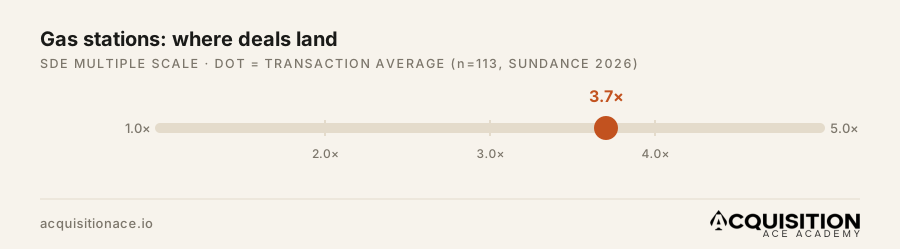
The short answer: gas stations sell for an average of 3.70× SDE across 113 reported transactions, one of the deepest vertical samples in the data. In dollars: roughly $740,000 for a station producing $200,000 of SDE. The business is two businesses: fuel brings the traffic at thin margins, the store inside carries the profit. The deal-breakers live in three files: the environmental record on the tanks, the fuel supply agreement, and the real estate.
Why buyers pick gas stations, and what they underestimate
The attraction is real: a cash-generating corner with daily demand, hard assets a lender can touch, and a deep resale market when it is your turn to exit; 113 reported transactions is more than trucking, car washes, and towing combined. What first-time buyers underestimate splits three ways. The margin structure: fuel is a traffic engine, not a profit engine, and a station without a real store is a different, weaker business. The environmental exposure: underground storage tanks carry liability that transfers with the ground. And the hours: this is retail, open early, closed late, staffed every day you own it.
What gas stations sell for
The transaction average is 3.70× SDE (113 reported deals), against 2.82× for standalone convenience stores and 2.70× for auto repair in the same dataset. The levers that move a specific station: the real estate (owned lots price the land on top; leaseholds live and die by the remaining term), the inside-sales share, the fuel contract, and the compliance file. Full numbers on the gas station multiples page; worked dollars on the cost-to-buy page.
The diligence that makes or breaks a station deal
| File | What you are looking for | Walk-away signal |
|---|---|---|
| Environmental / tanks | Tank age and type, tightness tests, state compliance history, any Phase I findings | Open remediation or records the seller cannot produce |
| Fuel supply agreement | Remaining term, pricing formula, assignment terms, supplier consent process | Above-market terms that bind you for years, or no assignment |
| Inside sales | Category mix, food service, lottery and age-restricted share, shrink | A store that is really a kiosk propping up thin fuel |
| Real estate or lease | Owned: survey, title, land value. Leased: term, renewals, rent steps | A short lease under a fuel-anchored business |
| Licenses | Lottery, tobacco, alcohol: transferability and timelines | Revenue that assumes licenses you cannot hold in time |
Buyers in forums run the same shorthand on every listing: price plus inventory, gallons, inside sales, rent. It is good shorthand. Each term maps to one of the files above, and the files, not the listing, are where the price gets real.
How a typical gas station purchase is financed
The standard path is an SBA 7(a) loan: 90% bank financing, a 10% equity injection on total project cost, up to half of it coverable by a seller note on full standby. On the worked $740,000 deal that is $666,000 of loan, $37,000 of standby note, and $37,000 of your cash, plus closing costs and a working-capital reserve that includes the first fuel loads. Two station-specific notes: lenders underwrite the environmental file as hard as the cash flow, and owned real estate brings the property into the collateral package (and often into a longer amortization). The full stack with the figure is on the cost-to-buy page.
Where to find gas stations for sale
Stations list heavily on the big marketplaces (BizBuySell and BizQuest compared here), through fuel-distribution brokers, and directly through supplier networks; distributors often know which of their dealer stations are quietly for sale. Listing hygiene matters more than volume: the price-plus-inventory convention, the real-estate question, and the contract terms are frequently missing from the ad and define the deal. The listing red flags guide applies in full.
Frequently asked questions
Gas stations sell for an average of 3.70 times SDE across 113 reported transactions. A station producing $200,000 of SDE prices around $740,000 at the average, with the real estate question moving a specific deal far in either direction.
The environmental file. Underground storage tanks carry remediation liability that can outlast the seller, so tank tests, compliance records, and a Phase I assessment are the diligence that protects the buyer. The second risk is a fuel supply agreement that does not assign on livable terms.
Fuel margins are thin and volatile; the fuel brings the traffic. The margin lives inside: the convenience store, food service, car wash add-ons, lottery and age-restricted categories. That is why the inside-sales share is the first number to check on any listing.
Only if it assigns. Branded supply agreements run for years and bind the station's economics, so the assignment terms, remaining term, and pricing formula belong in diligence before the offer, with the supplier's consent process started early.
Yes, with the standard 10% equity injection, about $74,000 on a $740,000 station, up to half available as a standby seller note. Lenders will want the environmental file clean, and real-estate deals bring the property into the collateral package.
Sources
- Sundance Financial, SDE Multiples by Industry (2026), averages across 9,500+ small-business transactions reported in 2025.
- SBA 7(a) structure per SOP 50 10 8.1 (effective October 1, 2026); worked figures on the cost-to-buy page.