The short answer: Gas stations price off the transaction average of 3.70× SDE across 113 reported deals. That puts a $150K-SDE station near $555,000, a $200K-SDE station near $740,000, and a $300K-SDE operation near $1.11M, before the land question moves the number. With an SBA 7(a) loan the 10% injection on total project cost is about $74K on a $740K station, half coverable by a standby seller note, so your cash can start near ~$37,000 plus the first fuel loads.
What gas stations actually cost
| Station size | SDE | 10% injection | Price anchor |
|---|---|---|---|
| Small neighborhood station | $150K | ~$56K | ~$555,000 |
| Typical first acquisition | $200K | ~$74K | ~$740,000 |
| High-volume corner with a real store | $300K | ~$111K | ~$1,110,000 |
One structural warning before the anchors settle in: stations sell both with the real estate and as leasehold businesses, and the same SDE prices very differently in the two cases. The anchors above are operating-business anchors; land, tanks, and canopy are valued on top when they travel with the deal.
How the price is set: the multiple
| Input | Figure | Note |
|---|---|---|
| SDE (owner earnings) | $200,000 | Verified in diligence, not taken from the listing |
| Transaction-average multiple | 3.70× | Across 113 reported deals, the deepest automotive sample |
| Price anchor | $740,000 | Before the real estate and contract levers move it |
What moves a station off the anchor: the inside-sales share (the store carries the margin that fuel does not), the fuel supply agreement and whether it assigns, the environmental file on the tanks, and the licenses. The full lever table is on the gas station multiples page.
The down payment and the full capital stack
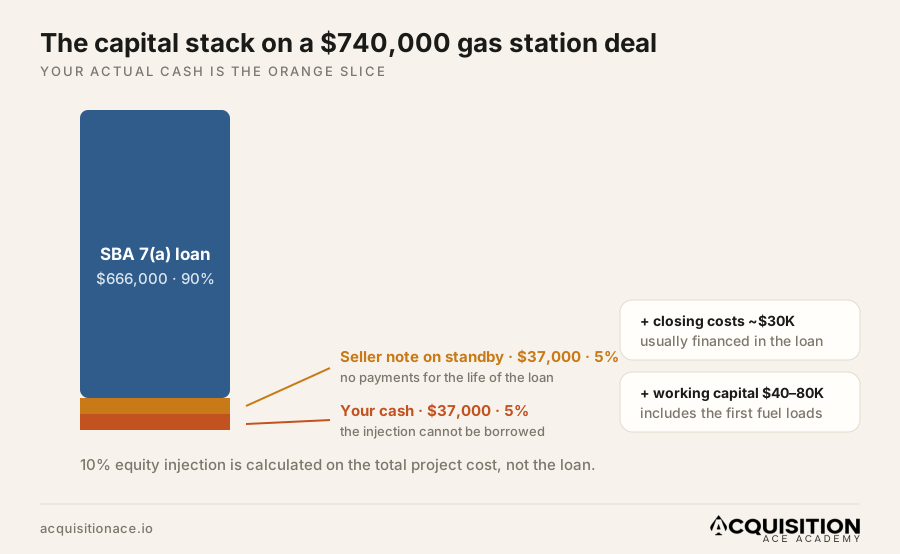
Under SBA 7(a) rules (SOP 50 10 8.1, effective October 1, 2026, which kept the injection rules unchanged), a change of ownership needs a minimum 10% equity injection on the total project cost, not the loan. Up to half can be a seller note on full standby, and the injection cannot come from borrowed funds. The worked stack on a $740,000 station:
| Source / use | Amount | % of price |
|---|---|---|
| SBA 7(a) bank loan | $666,000 | 90% |
| Your cash injection | $37,000 | 5% |
| Seller note (full standby) | $37,000 | 5% |
| Purchase price | $740,000 | 100% |
| + Est. closing costs & fees (financed) | ~$30,000 | |
| + Working-capital reserve incl. first fuel loads | $40K–$80K |
Leasehold or land included: two different checkbooks
The same $200K-SDE station is a different purchase depending on the ground under it. Leasehold: the price anchors near the operating figures above, your exposure concentrates in the remaining lease term, and the rent escalations belong in the DSCR math before you offer. Land included: the real estate is valued on top of the operating business and typically changes the lending conversation, since the property enters the collateral package and lenders can structure around the hard asset; it also brings the environmental file from important to decisive, because the liability you are diligencing sits in ground you would own. Neither is better in the abstract: the leasehold buyer pays less cash for more contract risk, the land buyer pays more for control. What fails is pricing one as if it were the other.
Costs buyers forget
Four items surprise first-time station buyers. Inventory at close: the listing convention is price plus inventory, so the fuel in the tanks and the store stock are counted and paid on top. The environmental file: lenders want tank tests and compliance records, and a Phase I environmental assessment is standard on the real-estate side. License transfers: lottery, tobacco, and alcohol each have their own clocks and fees, and revenue gaps while they transfer are real. The fuel supply agreement: assignment can carry fees or new-term negotiations with the supplier.
Frequently asked questions
Roughly $555,000 for a station producing $150,000 of SDE, $740,000 at $200,000, and $1.11M at $300,000, derived from the sourced 3.70× SDE average across 113 reported transactions. Whether real estate and tanks are included moves a specific station far off these anchors.
An SBA 7(a) purchase needs a 10% equity injection on the total project cost, about $74,000 on a $740,000 station. Up to half can be a standby seller note, so your own cash can start near $37,000 plus closing costs, fuel loads, and reserves.
Usually not: gas station listings are commonly quoted as price plus inventory, with fuel in the tanks and store stock counted and paid separately at close. Budget the first fuel loads into working capital; they are a real five-figure item.
On the total project cost, not the loan amount, and it cannot come from borrowed funds. A seller note on full standby can cover up to half of the required injection. SOP 50 10 8.1 (effective October 1, 2026) kept these injection rules unchanged.
Sources
- Sundance Financial, SDE Multiples by Industry (2026), averages across 9,500+ small-business transactions reported in 2025.
- SBA 7(a) equity injection rules per SOP 50 10 8.1 (effective October 1, 2026); injection minimum and standby-note cap unchanged from SOP 50 10 8.