The short answer: Home care agencies price off the transaction averages: 2.84× SDE or about 0.60× revenue across 92 reported deals. That puts a $500K-revenue agency near $300,000, a $1M agency near $600,000, and a $2M staffed office near $1.2M. With an SBA 7(a) loan the 10% injection on total project cost is about $60K on a $600K agency, half coverable by a standby seller note, so your cash can start near ~$30,000 plus reserves.
What home care agencies actually cost
Price scales with revenue and payer quality, not office size:
| Agency | Revenue | Implied SDE | Typical price |
|---|---|---|---|
| Owner-operated | $500K | ~$90K | ~$300,000 |
| Typical first acquisition | $1M | ~$180K | ~$600,000 |
| Staffed office | $2M | ~$350K | ~$1.2M |
The asterisk on every home care price is the payer mix: private-pay books at self-set rates price above these averages, single-program Medicaid dependence below them, and change-of-ownership re-credentialing timelines decide how fast the revenue is actually yours.
How the price is set: the multiple
Two sourced methods, same dataset of 92 transactions:
| Method | Implied price | Reading |
|---|---|---|
| 0.60× revenue on $1M | ~$600,000 | The revenue yardstick across 92 reported deals |
| 2.84× SDE on $150K | ~$430,000 | The earnings yardstick at the same average |
| 2.84× SDE on $300K | ~$850,000 | Where a well-run staffed agency lands |
When the two methods disagree, the earnings method usually carries the negotiation, and payer quality explains the gap. See the sourced figures on the home care agency multiples data page and the mechanics in valuation.
You are buying the census and the caregivers who serve it. Everything else is office furniture.
The down payment and the full capital stack
Under SBA 7(a) rules (SOP 50 10 8.1, effective October 1, 2026, which kept the injection rules unchanged), a change of ownership needs a minimum 10% equity injection, calculated on the total project cost, the price plus financed fees, not on the loan amount. Up to half of it can be a seller note on full standby, and the injection cannot come from borrowed funds. The worked stack on a $600,000 home care agency:
| Source / use | Amount | % of price |
|---|---|---|
| SBA 7(a) bank loan | $540,000 | 90% |
| Your cash injection | $30,000 | 5% |
| Seller note (full standby) | $30,000 | 5% |
| Purchase price | $600,000 | 100% |
| + Est. closing costs & fees (financed) | ~$25,000 | |
| + Working-capital reserve | $30K–$50K |
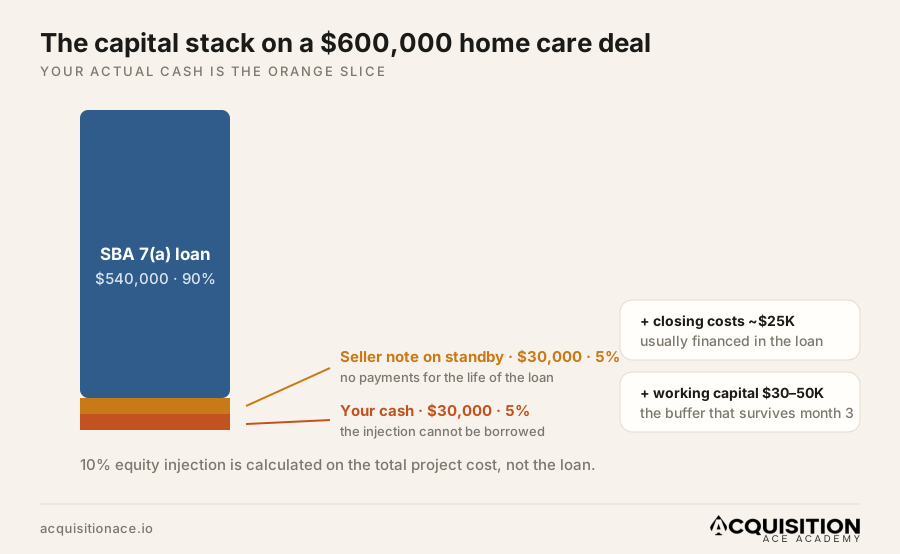
The honest cash to close is the ~$30,000 injection plus reserves. The injection is calculated on the total project cost and cannot be borrowed. Budget the licensing timeline alongside the money: state change-of-ownership approval and payer re-credentialing set when the revenue starts being yours.
Does the deal cash-flow?
At ~$180K SDE and roughly $84K of annual debt service on a $565K financed total, coverage sits near 2.1× if the census holds through transition, which is what the caregiver-retention plan is for. Check any structure against a DSCR of ~1.15× to 1.25× before you sign anything.
Costs buyers forget
- Change-of-ownership licensing, state approval and payer re-credentialing; start before closing or the billing gaps.
- SBA guarantee & packaging fees, a percentage of the guaranteed amount, usually financed.
- Legal & closing, purchase agreement, entity setup, license filings.
- Caregiver retention costs, stay bonuses for key caregivers are cheaper than re-staffing a census.
- Billing reconciliation review, scheduling-to-invoice verification before trusting the stated hours.
- Working capital, payer receivables lag; the buffer carries payroll while claims pay.
Model your home care agency deal end to end
Price, down payment, loan payment, and take-home in one place.
Frequently asked questions
Roughly $300,000 for a $500K-revenue agency, $600,000 at $1M, and $1.2M at $2M, derived from the sourced 0.60× revenue average across 92 reported transactions. Payer mix moves a specific agency above or below these figures.
An SBA 7(a) purchase needs a 10% equity injection on the total project cost, about $60,000 on a $600,000 agency. Up to half can be a standby seller note, so your own cash can start near $30,000 plus closing costs and reserves.
Yes, home care is state-licensed, and a change of ownership typically requires state approval plus re-credentialing with payers. The timelines vary by state and belong in the closing plan, because billing gaps leak the census you just bought.
On the total project cost, the price plus financed fees, not the loan amount, and it cannot come from borrowed funds. A seller note on full standby can cover up to half of the required injection.
Sources
- Transaction averages, Sundance Financial, SDE Multiples by Industry (2026), averages across 9,500+ small-business transactions reported in 2025.
- Multiples, Acquisition Ace home care multiples.
- Financing structure & equity injection, SBA 7(a) program; SOP 50 10 8. See our SBA loan guide.